When Code Meets Curriculum: The Unspoken Grind of Being a Student and a Developer
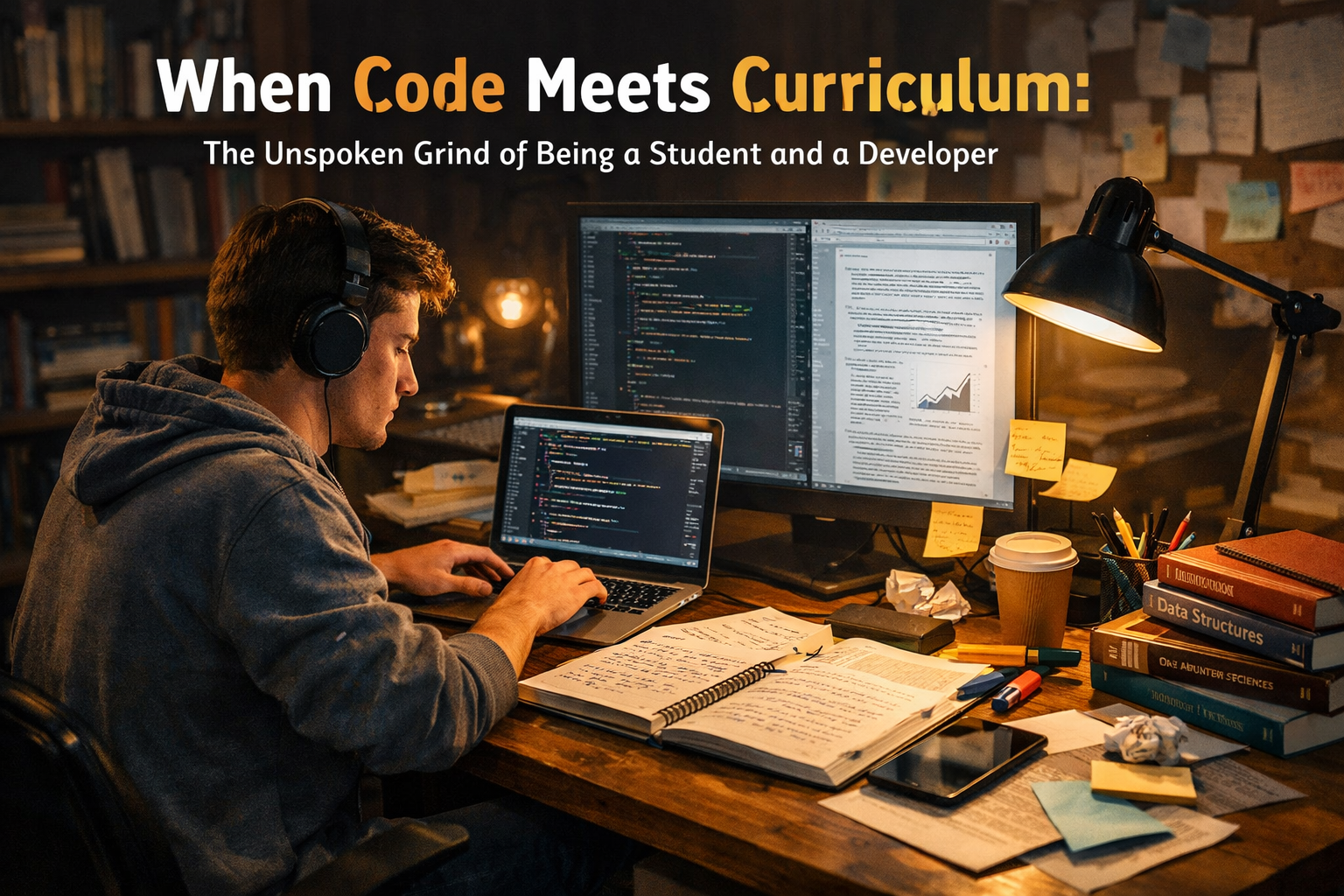
Assignments on one tab, a half-broken project on the other. Attendance shortages, mid-sem panic, and a side project that refuses to compile. If you are a student who also builds things — especially from a non-CSE branch — you already know this life. This is the honest, unfiltered story of what it actually feels like to carry both worlds at once, and why that struggle quietly makes you better than you realise.
Two Worlds, One Person
There is a very specific kind of exhaustion that only a student-developer knows. It is not just the exhaustion of late-night debugging sessions or the panic of a submission deadline approaching fast. It is the exhaustion of living two parallel lives at the same time — one inside a classroom, and one inside a code editor.
On one side, there are assignments with strict word counts, lab reports that need to be handwritten, attendance registers that do not care whether you were up until 3 AM fixing a broken API call. On the other side, there is a project that is half-built, a GitHub repo with too many uncommitted changes, and a learning curve that never really flattens out.
Most people around you see only one of these worlds. Your professors see a student who sometimes looks distracted. Your developer peers see someone who codes. Very few people see both — and even fewer understand what it costs to maintain them simultaneously.
The Academic Calendar Does Not Care About Your Side Project
The academic year has its own rhythm, and it is relentless. Assignments pile up from the very first week. Attendance registers fill with absences on the days you stayed in to push a feature or debug something that had been bothering you for hours. Internal assessments sneak up before you have had time to open the syllabus properly.
And then there is the mid-semester examination — that peculiar academic invention designed to arrive precisely when you have just found your stride in a project. You are finally making progress on something real, something you built from scratch, and the calendar pulls you back into memorising theory that feels miles away from anything you actually do.
The end-semester examination is its own category of pressure entirely. Weeks of syllabus compressed into days of revision. The code gets closed. The projects get paused. You switch modes entirely and try to convince yourself that you still remember what you studied in Unit One back in August.
Every student knows this pressure. But when you are also a developer, the cost is doubled. Because while you are sitting in an exam hall writing about topics that may or may not matter to your future, your mind is already thinking about the bug you left unresolved, the feature that is almost done, the deployment that needs to happen.
Being Non-CSE Changes Everything
Now here is where it gets genuinely interesting — and genuinely harder. Spare a thought for the student-developer who does not belong to a Computer Science or CSE specialisation branch.
CSE students have it difficult too, no question. But they have something that non-CSE developers do not: a curriculum that at least partially rhymes with what they are building. They have lab sessions that touch on relevant concepts. They have classmates who understand what a merge conflict is. They have professors who might, occasionally, appreciate what they are working on outside of class.
The Electrical Engineering student who codes. The Mechanical undergraduate maintaining a web app. The Civil branch student who taught themselves backend development because it genuinely excited them. These people are building in the dark. No structured pathway. No supportive peer group that relates to both sides of their life. No professor who nods approvingly when you mention you spent the weekend working on a REST API.
Instead, they sit in lectures about subjects that feel entirely disconnected from the things they are passionate about, take notes they will need to reproduce in exams, and then go back to their rooms and open their laptops and build things that nobody in their academic circle fully understands.
There is a particular kind of loneliness in that. And also, if you pay close enough attention, a particular kind of strength.
The real challenge is not the code, and it is not the exam. It is carrying both at once — without dropping either — and doing it without a roadmap.
The Problems You Face Become the Products You Build
Something remarkable happens to student-developers who are pushed to figure things out on their own. Because the system does not hand them solutions, they are forced to become problem-solvers in the truest sense. Not problem-solvers who follow a textbook method, but problem-solvers who look at an actual friction point in their daily life and think: I could fix this.
The attendance tracker that alerts you when you are getting close to the shortage threshold — built by a student who had already crossed it once and never wanted to again. The assignment deadline reminder app that sends a notification three days before, one day before, and the morning of — built by someone who submitted something late and decided it would never happen again. The CGPA calculator that tells you exactly what you need to score in your finals to hit the number you are aiming for — built at 1 AM by someone who needed the answer immediately and did not want to do the math by hand.
These are not impressive portfolio projects by the standards of the tech industry. But they are real. They solve actual problems. They were built under real constraints — limited time, limited energy, a full academic schedule sitting on top of the development work. And they work.
That is what separates the student-developer from someone who just learns coding in isolation. The problems are real. The motivation is personal. The feedback loop is immediate. If something breaks, you feel it. If something works, you feel that too.
The Things Nobody Tells You Going In
You will miss deadlines sometimes — academic ones because of your project, or project ones because of your academics. That is not failure. That is the reality of managing two demanding things at once. The skill is in learning which one needs you more on any given day.
Being from a non-CSE branch does not put you behind. In many ways, it puts you ahead. You learned to code because you wanted to, not because your curriculum required it. That kind of motivation is difficult to manufacture and impossible to fake.
The loneliness of building something that your classmates do not fully understand is temporary. The internet is full of people who get exactly what you are doing. Communities exist. You just have to find them and show up.
Impostor syndrome is louder when you are surrounded by people who share neither your academic world nor your developer world. Remember: you exist in both. That is not a weakness. That is a genuinely rare combination.
The projects you build to solve your own problems are often better than the ones you build trying to impress someone. Build for yourself first. The portfolio will follow.
Time management for a student-developer is not a productivity hack. It is survival. Learn it early, iterate on it constantly, and do not feel bad when a system stops working — just build a new one.
Showing up consistently, even on the days when neither the code nor the coursework is going well, is what separates people who eventually get somewhere from those who do not.
What This Life Quietly Builds in You
The grind of being a student-developer — especially a non-CSE one — is not glamorous. It does not always look impressive from the outside. There are no highlight reels of sitting in an exam hall wishing you were debugging instead, or closing your laptop at midnight because the assignment is due tomorrow and the project will have to wait.
But here is what that grind quietly builds, almost without you noticing: resilience, adaptability, and an instinct for problem-solving that is grounded in reality rather than theory. You learn to ship things under pressure because your entire college life is pressure. You learn to keep going when something is not working because stopping is not really an option. You learn to context-switch — from engineering principles to software architecture, from exam revision to code review — in ways that most people never have to.
And perhaps most importantly, you learn that the constraints are not the enemy. The constraints are the curriculum. Every limitation you work around teaches you something that no tutorial ever will.
To the Student Who Has a Browser Tab Open Right Now
If you are reading this with one tab open for your assignment and another open for Stack Overflow — this is for you. If you have missed a lecture because you were too deep in a bug to notice the time — this is for you. If someone has ever asked why you are learning to code when your branch has nothing to do with software — this is definitely for you.
What you are doing is harder than it looks. Carrying two worlds without a map, without guaranteed support, without the comfort of fitting neatly into either category — that takes something. And you are doing it anyway.
The pain is real. The exhaustion is real. But so is the instinct that got you here — the one that said I want to build something, and did not wait for permission from the curriculum.
Keep going. The people who build their way out of problems are exactly the kind of people the world needs more of. And you are already one of them.